
Strategic goals, priorities and dependencies
Part 3/4
You’ve set the direction for your business, you know why you’re going there and when, and now you know how you’ll respond to the things that might come up along the way. That’s pretty sweet!
It gets even sweeter when you start setting some goals that you can achieve along the way. Goals that turn a strategy into something that is being worked on every day, and keeps the strategy out of the top drawer (check part 1 if you don’t get the reference).
So, how do you get started on setting your goals?
Setting your goals
To get started on setting your goals you need to take a look at what you’ve done already, in particular, take a look at your opportunities and the responses (“what am I going to do about it?”) that you wrote for them.
Generally speaking, the opportunities are where you should have some control. If we use an Opportunity example from part 2; “Workshop delivery generates more leads than expected” this is something we have some control over. If we don’t deliver any workshops, we won’t get any leads, let alone more than we expected, but if we deliver a workshop every month, or every quarter, we’re going to get better at delivering workshops which might get us more leads than we expect.
We now have the chance to set a goal about delivering workshops.
A good goal should be SMART.
Specific - The goal should be targeted to one specific thing.
Measurable - You should be able to easily measure whether you achieved your goal or not.
Attainable - The goal should be something that you can achieve with current resources/ skills.
Realistic - The goal should not be so lofty that you can’t realistically achieve it, or so easy that it doesn’t stretch you in any way.
Timely - The goal should have a deadline for when you aim to achieve it.
With that in mind, a goal about delivering workshops might look like this:
“Utilise my relationships with local special interest and chamber of commerce organisations to deliver at least one free workshop to their members each quarter in the year June 15, 2026 to June 15, 2027. Aiming for 2 new leads from each workshop”
Specific - “Utilise my relationships with local special interest and chamber of commerce organisations to deliver at least one free workshop to their members …”
Measurable - “...deliver at least one free workshop to their members each quarter…”
Attainable - Yes - utilises existing relationships. Workshops are free.
Realistic - Yes - One workshop per quarter = enough time to prepare quality workshops. Expecting 2 leads per workshop, assuming 10 people attend = 20% lead generation. Leads could be a coffee catch up to talk more.
Timely - “...each quarter in the year June 15, 2026 to June 15, 2027…”
If you take this approach across all of your opportunities and threats you should end up with a decent list of goals for your business. And you can take it one step further by looking at where you want to go and why to uncover things that might not be related to opportunities and threats but still drive the business forward.
Dependencies
Sometimes our goals have dependencies between one another.
That means that we can’t start, finish, or achieve one goal until we’ve started, finished, or achieved another.
We need to identify these dependencies so that we can prioritise our goals and effectively sequence them.
For example, if you have a goal of hiring a new staff member, that might depend on increasing revenue by 20% so that the business can sustainably fund the additional wage costs.
In this example, the revenue growth goal is a dependency of the hiring goal. Before you can successfully hire someone, you'll need a plan to generate that additional revenue.
Hiring before the business can comfortably support the cost is a bit like putting the cart before the horse. It can create financial pressure for the business and uncertainty for the new employee. Understanding the dependency helps you tackle your goals in the right order and gives both a better chance of success.
Priorities
One of the biggest mistakes I see business owners make is trying to tackle too many goals at once. Progress tends to happen much faster when you're focused on the handful of goals that will have the biggest impact, rather than spreading your effort across everything at the same time.
With your goals set and knowing any dependency between them you can take an eyes wide open look at how to prioritise achieving those goals.
Prioritisation should take into account the impact of achieving a particular goal on your business and where you want it to be, as well as your current ability to achieve the goal.
To make prioritisation easier, plot your goals on the matrix below to see which you should do first (the goals with the highest impact that you have the greatest ability to do), second, third, and last (the goals with the least impact and the least ability to do).
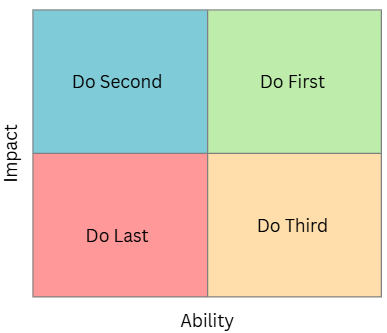
Once you have all of your goals plotted, make a sequenced list of your priorities i.e. if you have ten goals, list them out 1 through 10 based on where they landed on the matrix (high impact, high ability = 1, low impact, low ability = 10).
For example, if one goal is to increase revenue by 20% and another goal is to redesign your logo, the revenue goal is probably going to have a greater impact on your business and should be prioritised higher.
Now that you’ve got a sequenced series of goals that will help your business to achieve its strategy you’ll need to …
Turn your Goals into Action!
The final part of this series will look at defining the activities that you’ll need to complete so that you can achieve your goals and bring that strategy to life!
As always, let me know how you’re going, and get in touch if you need a hand.